
Kinderneurologie / Bewegungsstörungen
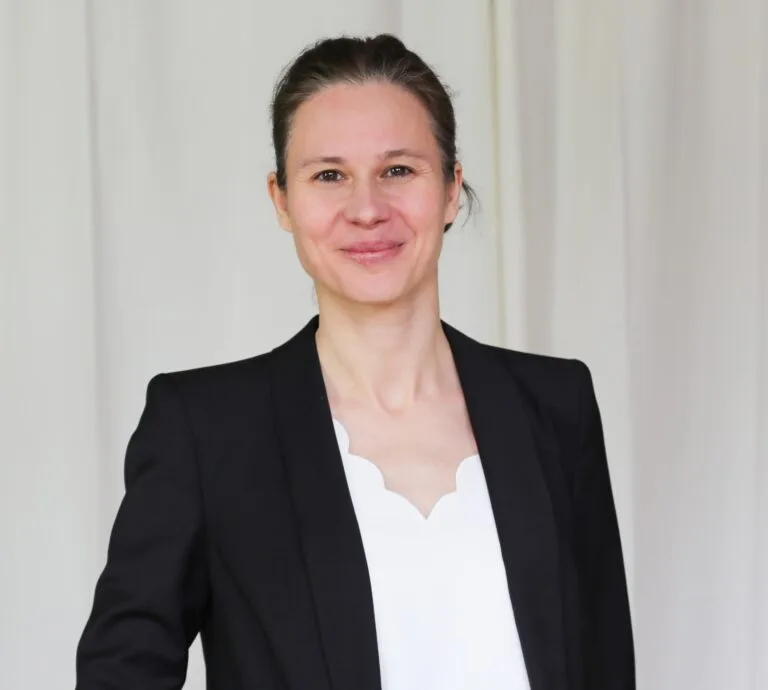
Sandy Siegert
Fachärztin für Kinder- und Jugendheilkunde mit Weiterbildungsschwerpunkt Kinderneurologie
Diplompsychologin
Spezialistin für Bewegungsstörungen im Kindesalter
Wissenschaftliche Expertise in den Bereichen
- Pädiatrische Bewegungsstörungen
- Tiefe Hirnstimulation
- Seltene genetische Erkrankungen
- Virtual Reality bei Bewegungsstörungen
Berufliche Tätigkeit
- Fachärztin an der Kinderklinik AKH Wien
- Ambulanz für Allgemeine Neuropädiatrie, Spezialambulanz für Pädiatrische Bewegungsstörungen
Studium
- Humanmedizin: Charité – Universitätsmedizin Berlin
- Psychologie: Universität Leipzig, Diplomarbeit am Max-Planck-Institut für Kognitions- und Neurowissenschaften
Fachgruppenmitgliedschaften
- Arbeitsgruppe für Neuropädiatrie
- European Paediatric Neurology Society
- Österreichische Gesellschaft für Kinder-und Jugendheilkunde
Publikation: Developmental, Cognitive, Ocular Motor, and Neuroimaging Findings Related to SUFU Haploinsufficiency: Unraveling Subtle and Highly Variable Phenotypes
Developmental, Cognitive, Ocular Motor, and Neuroimaging Findings Related to SUFU Haploinsufficiency: Unraveling Subtle and Highly Variable Phenotypes. Siegert S(1), Grisold A(2), Pal-Handl K(3), Lilja S(4), Kepa S(5), Silvaieh S(2), Laccone F(6), Wiest G(2), Pogledic I(7), Schmook MT(7), Boltshauser E(8), Schmidt WM(4), Krenn M(9). Author information: (1)Division of Pediatric Pulmonology, Allergology and Endocrinology, Department of Pediatrics and Adolescent Medicine, Medical University of Vienna, Vienna, Austria; Comprehensive Center for Pediatrics, Medical University of Vienna, Vienna, Austria. (2)Department of Neurology, Medical University of Vienna, Vienna, Austria; Comprehensive Center
https://www.sciencedirect.com/science/article/pii/S0887899424002790
Publikation: Expanding the Phenotype of the FAM149B1-Related Ciliopathy and Identification of Three Neurogenetic Disorders in a Single Family
Biallelic truncating FAM149B1 variants result in cilia dysfunction and have been reported in four infants with Joubert syndrome and orofaciodigital syndrome type VI, respectively. We report here on three adult siblings, 18 to 40 years of age, homozygous for the known FAM149B1 c.354_357delinsCACTC (p.Gln118Hisfs*20) variant. Detailed clinical examinations were performed including ocular and gait analyses, skeletal- and neuroimaging. All three patients presented with neurological and oculomotor symptoms since birth and mild skeletal dysplasia in infancy resulting in characteristic gait abnormalities. We document mild skeletal dysplasia, abnormal gait with increased hip rotation and increased e
https://www.ncbi.nlm.nih.gov/pmc/articles/PMC8622907/
Publikation: Error signals in the subthalamic nucleus are related to post-error slowing in patients with Parkinson's disease
Author information: (1)Department of Neurology, Charité-University Medicine Berlin, Berlin, Germany. (2)Department of Neurosurgery, Charité-University Medicine Berlin, Berlin, Germany. (3)Center for Behavioral Brain Sciences, Magdeburg, Germany; Otto von Guericke University, Institute of Psychology II, Magdeburg, Germany; Radboud University Nijmegen, Donders Institute for Brain, Cognition and Behaviour, Nijmegen, The Netherlands. (4)Department of Neurology, Charité-University Medicine Berlin, Berlin, Germany; NeuroCure, Charité, Charité-University Medicine Berlin, Berlin, Germany; Berlin School of Mind and Brain, Berlin, Germany. Electronic address: andrea.kuehn@charite.de. Error monitoring
https://pubmed.ncbi.nlm.nih.gov/24525245/